
"I did the research so the birds could do the rest."
— an Ontario gardener, on her cardinal flower
"Really Missing All the Birds": Why Feeders Come Down in Late Summer
There's a particular kind of guilt that arrives in August when you walk past your empty feeder hook. You did the right thing — you saw a house finch with swollen, crusty eyes, or spotted a bird with warty growths on its beak, and you took action.
Mycoplasmal conjunctivitis and Avian Pox both spread readily at feeders, where birds cluster close together and share surfaces. Taking feeders down interrupts that transmission.
But it still feels terrible. Sorry to all the healthy birds that come by.
Responsible pest management lands some Ontario gardeners in the same position from a different angle — rats or other unwanted visitors turning a backyard feeder into a neighbourhood problem, and feeders coming down until the situation is sorted.
Whatever the reason your feeders are offline right now, the emotional reality is the same: the yard feels quieter, and you miss them. This guide is written for exactly that window — the stretch of August when feeders are down, the birds are still out there, and your garden may already be doing more than you realize.
What's Producing Food in Ontario Right Now
Here's the thing about late summer in Ontario: while it can feel like a bird-quiet time, it's actually one of the most productive natural foraging windows of the year — if you know where to look.
Purple coneflower (Echinacea purpurea) is at or near peak seed-set through August and into September. Those spiky brown centres you might be tempted to deadhead? Leave them. Seeds are ripening right now.
Black-eyed Susan (Rudbeckia hirta) follows a similar arc — the cheerful yellow blooms give way to seed-packed centres that are irresistible to a surprisingly long list of birds. August is prime time.
Joe-Pye weed (Eutrochium spp.) is a tall, late-season native that reaches its own seed-set window right alongside the others. It's big, it can feel a bit unruly, and it is doing excellent work.
And then there's cardinal flower (Lobelia cardinalis) — which belongs in this garden but plays a completely different role. Cardinal flower is in peak bloom right now, not peak seed-set. It is the hummingbird plant of this window, offering tubular red flowers loaded with nectar right when Ruby-throated Hummingbirds are fuelling up before fall migration. It belongs alongside your seeding plants, but it earns its place differently — more on that in the next section.
Which Birds Use Which Plants, and How
Once you know what's out there, the matching becomes almost intuitive.
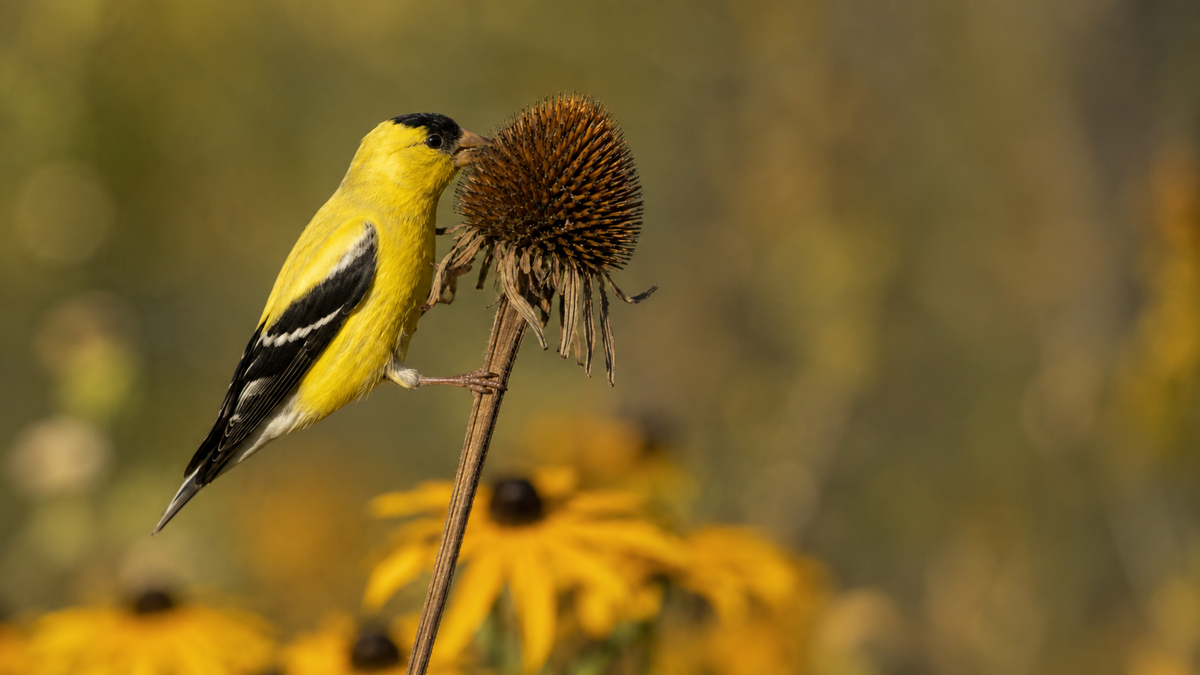
Goldfinches on coneflower is one of the most reliable sightings in an Ontario garden in August. They will cling directly to the dried seedhead, often hanging at odd angles, and methodically work the seeds out. If you have coneflowers and you have goldfinches in your neighbourhood, this is going to happen with or without your intervention — you just need to not cut them back.
Chickadees and pine siskins gravitate toward black-eyed Susan. These are birds comfortable with smaller, more compact seedheads, and black-eyed Susan suits them well. Pine siskins are irregular visitors in Ontario — some years they're abundant, other years absent — but when they arrive in late summer or fall, native seedheads are exactly what they're looking for.
Ruby-throated Hummingbirds and cardinal flower is a pairing worth dwelling on. The tubular red blooms are shaped almost perfectly for a hummingbird's bill — and native to Ontario, so the relationship goes back a long way. Experienced Ontario gardeners describe watching a hummingbird bounce around to four or five different flowers on a single cardinal flower plant, then circle back and do it again. This is a bird in active foraging mode, putting on the energy reserves it needs for migration. If you want to support hummingbirds right now, cardinal flower — paired with a clean hummingbird feeder if you still have one running — is where to focus. You can find cardinal flower and coneflower kits to establish both for this purpose.
Joe-Pye weed offers something the compact plants don't: height. Birds will perch on the tall stems and access the seeds from above — a different foraging behaviour worth watching for.
The "Idea Worked" Trick: Using What's in Your Garden Right Now as a Feeder Substitute
This one emerged from the kind of practical ingenuity that comes from a quiet feeder and a garden full of coneflowers. The method is simple, it works, and you can try it in the next fifteen minutes.
The coneflower-stem-in-suet-cage method:
- Walk out to your coneflower patch and identify a few stems with seedheads that are visibly dried and brown-centred — not still in flower, but genuinely past their bloom and into seed-set.
- Cut a small handful of stems, leaving enough on the plant that you're not stripping it bare.
- Take your empty suet cage — the wire cage feeder you'd normally pack with suet blocks — and push the coneflower stems inside, seedheads pointing outward or upward.
- Hang it in a spot where birds already feel comfortable: near a hedge, shrub edge, or the tree line.
- Step back.
One Ontario gardener reported a pair of goldfinches on the seedheads within fifteen minutes. The cage concentrates the activity in a visible spot and gives birds the familiar grip-and-cling access they're used to from a feeder. It's not a perfect replica of your black-oil sunflower setup — but it's working with what's already in the garden, which is the whole point.
This extends naturally to black-eyed Susan stems — they're smaller, so bundle a few more together. Joe-Pye weed can be tried the same way, though its stems are thicker and may need some creative arrangement in the cage.
This is a bridge strategy, not a permanent solution. It's something you can do today, with what you have, while your feeders are offline and your garden is at its most generous.
Leave It Standing: Why Not Cutting Back Is the Most Important Thing You Can Do
There is a deeply ingrained tidying instinct that kicks in when flowers go past their bloom — the urge to deadhead, cut back, and restore visual order. In most of the garden, this is fine. In the patch where your coneflowers, black-eyed Susans, and Joe-Pye weed are standing, it is worth resisting.
Seedheads left standing through August, September, and into October are the functional equivalent of a filled feeder. The seeds are there, they're accessible, and birds know how to find them. When you cut the stems to the ground in a fit of August tidying, you remove the food source entirely.
The philosophy that's emerged among Ontario naturalist gardeners is something like: let one area of the yard go a little "overgrown" by conventional standards. Not the whole garden — just the corner or the border where the natives live. A standing coneflower with a dried seedhead might look spent, but to a goldfinch it looks like lunch, and there's a bigger reason to let that corner stay wild: native plants are what feed the caterpillars that feed the next generation of birds.
Practical guidance:
- Leave coneflower and black-eyed Susan stems standing until you stop seeing bird activity on them — often well into October, sometimes later.
- Joe-Pye weed can stay up even longer; the tall structure also provides winter cover.
- If you do cut anything back in August, use those stems in your suet cage rather than the compost.
- You don't need a formal plan. The main action here is inaction: don't cut, and watch what happens.
Planning Ahead: Native Plants to Add So Next August Takes Care of Itself
If this summer has you thinking about building a more reliable late-summer food source, you're in the right frame of mind at the right time. Fall is actually an excellent planting window for many native perennials in Ontario — the soil is still warm, roots have time to establish before freeze-up, and spring emergence is strong.
The core trio for an Ontario bird garden is the same three plants we've been discussing: purple coneflower, black-eyed Susan, and Joe-Pye weed. All three are Ontario natives, reasonably adaptable to a range of growing conditions, and genuinely productive by their second season. Add cardinal flower to the mix if you want to support hummingbirds and pollinators through the peak late-summer window.
Basic siting notes for Ontario:
- Coneflower and black-eyed Susan both prefer full sun and tolerate the clay-heavy soils common in many Ontario yards.
- Joe-Pye weed is adaptable and will do well in slightly moister spots — a low corner of the yard that tends to stay damp is ideal.
- Cardinal flower appreciates consistent moisture and partial shade tolerance, making it useful near downspouts or in a shadier border.
You don't need a large footprint. Even a modest 3×3 metre corner planted in these species will be productive by year two and largely self-sustaining after that. We're building our Ontario native-plant kits around exactly this kind of late-summer bird-feeding goal — regionally appropriate species, bundled in garden-tested groupings.
Whether you plant this fall or plan for spring, you're setting up next August to take care of itself.
Bringing Feeders Back Safely
When you're ready to put feeders back up, a minimum two-week feeder-down window is the widely followed practice among experienced birders — and some wait longer if they're still seeing affected individuals in the area. Before feeders go back up, a thorough clean and disinfection is essential; surfaces where sick birds have landed can harbour pathogens that will affect the next wave of visitors.
A full feeder disease protocol article with Canadian-sourced guidance is coming — it will cover step-by-step cleaning instructions and return timing in the depth this topic deserves.
One Reminder for Reopening Day: Placement
Before you rehang that feeder, it's worth a quick check on placement — because returning a feeder after a shutdown is a natural moment to reconsider where it's going.
The widely followed safety principle for window-strike prevention comes down to distance: place feeders within 1 metre of a window (close enough that birds don't build dangerous speed before impact) or beyond 10 metres (far enough that they have time to redirect). The dangerous middle zone is the stretch between those two points — feeders in that range give birds just enough distance to reach harmful speeds if they startle toward the glass.
If your feeder was previously in that middle range, a shutdown and rehang is a good opportunity to move it.
Frequently Asked Questions
I had to take my feeders down because of a sick house finch. What can I actually do for the birds in the meantime?
The timing might be better than you think. If it's late summer, your garden is likely full of natural food right now. Coneflower and black-eyed Susan seedheads are at peak ripeness in Ontario through August and September — goldfinches especially will work them hard. If you've already cut some stems back, try what one birder discovered: stick a handful into your empty suet cage. One gardener reported a pair of goldfinches hanging out within 15 minutes.
I noticed a finch with a crusty eye / a wart on its beak. Should I remove my feeder for a few weeks?
Yes — taking feeders down for a minimum of two weeks is the right call. Clean and disinfect before putting feeders back up. In the meantime, native seedheads in your garden do the work without crowding birds together.
What's the consensus on how long to keep the feeder down after seeing a sick bird?
Two weeks is the minimum most experienced birders follow, and some wait longer if they keep seeing affected individuals. We're preparing a full Canadian-sourced protocol guide — in the meantime, the native plants in your garden (coneflower, black-eyed Susan, Joe-Pye weed) don't concentrate birds the way a feeder does, so leaving them standing is a safe way to keep supporting birds through the break.
I spent some time researching which plants attract hummingbirds — is cardinal flower actually worth it?
Lobelia cardinalis is genuinely one of the best plants you can put in an Ontario garden for Ruby-throated Hummingbirds. It flowers in mid-to-late summer right when hummingbirds are fattening up before migration, the tubular red blooms are shaped for hummingbird bills, and it's native to Ontario so it's doing real ecological work at the same time. One gardener described watching a hummingbird "bounce around to 4–5 different flowers" on a single plant — and then kept coming back. It's worth doing the homework.
Do goldfinches really use coneflower seedheads, or is that just something people say?
They really do — and in Ontario in August, you may not need to do anything at all. Just leave the spent flower heads standing rather than cutting them back. Goldfinches will cling directly to the stems and pick seeds from the dried seedheads. If you want to concentrate the activity in one spot, cut a few stems and push them into an empty suet cage near a hedge or shrub where the birds already feel comfortable.
Which native plants are seeding right now in Ontario that birds will actually eat?
In mid-to-late August, the main seedhead plants are purple coneflower (Echinacea purpurea), black-eyed Susan (Rudbeckia hirta), and Joe-Pye weed (Eutrochium spp.) — all at or near peak seed-set. Cardinal flower (Lobelia cardinalis) belongs in the same garden but works differently: it's in peak bloom right now, feeding hummingbirds nectar rather than producing seedheads. Together they make this the most useful window to use what you already have — or plan what to plant for next year.
My neighbour is feeding birds and we're getting rats. What can she use instead that won't attract them?
A few practical switches help a lot: hull-less or shelled sunflower seed (no debris to pile up on the ground), nyjer/thistle in a dedicated thistle feeder (finches eat it in place, very little falls), and switching to a tray feeder with a catch tray so seed doesn't scatter. Native plants are also worth mentioning — a garden with coneflower and black-eyed Susan seedheads feeds goldfinches and chickadees without leaving anything on the ground for rodents.


