
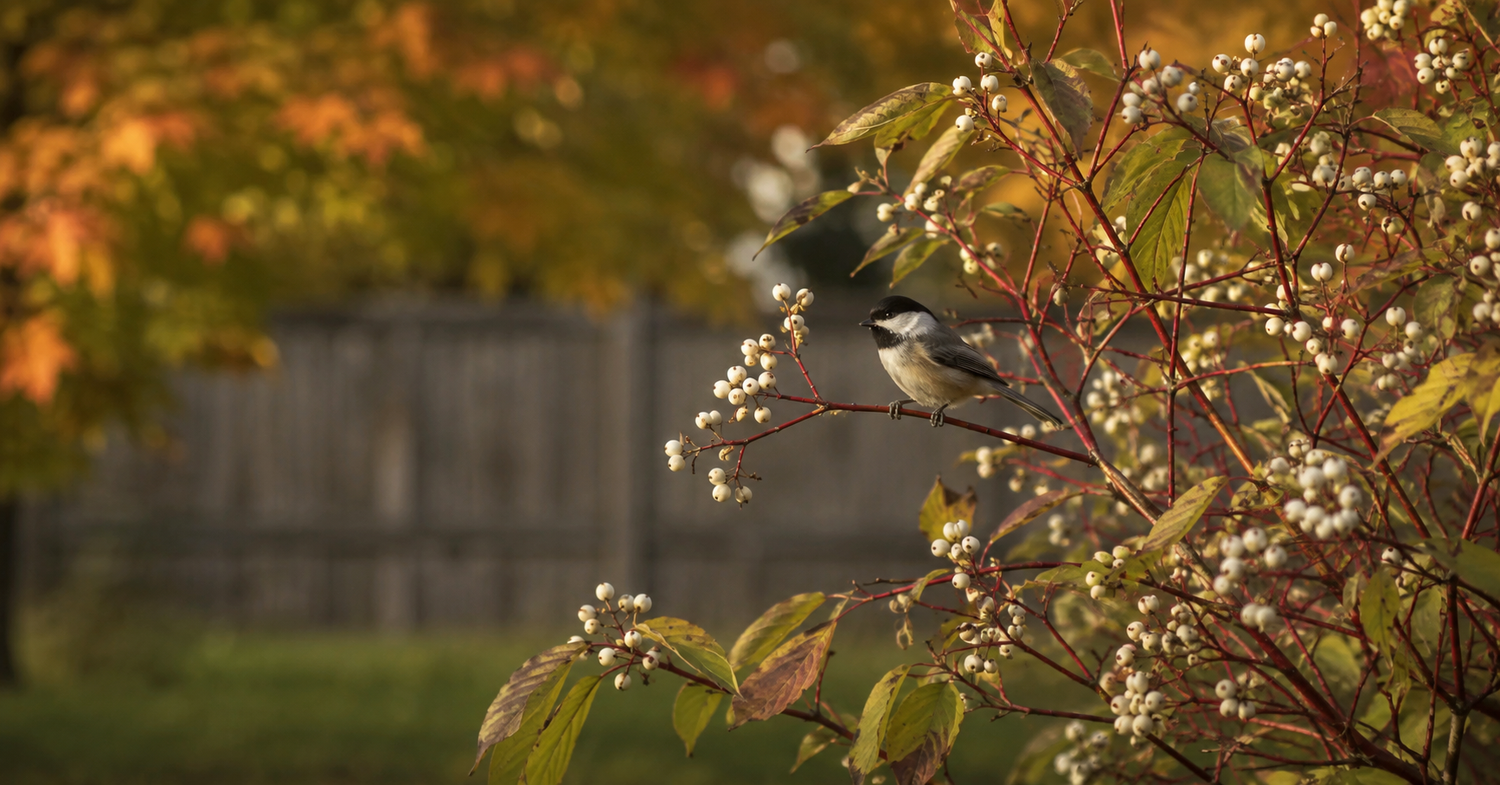
A feeder is an invitation. Habitat is a home.
The Full Feeder Question
If you feed birds, you know the rhythm. The feeder goes up, the chickadees find it within days, and before long your mornings have a cast of regulars — the cardinal pair at dawn, the nuthatch working down the pole headfirst, the goldfinches arguing over the good perch.
And then, sometime in June, it goes quiet. Not empty — but quieter than the crowd all that seed seemed to promise. The birds are still around. You can hear them. They're just somewhere else, busy with something your feeder apparently can't help with.
They're raising their young. And here is the part that changes how you see your backyard: almost none of them are doing it on seed.
This is the story of what a feeder actually does, what it can't do, and why the answer to a livelier backyard isn't a second feeder — it's a shrub. Food attracts birds. Habitat keeps them coming back.
What a Feeder Actually Does (and Doesn't)
Let's be clear about something first: we are not about to talk you out of your feeder. A well-kept feeder is one of the best things you can offer the adult birds in your neighbourhood — a reliable, high-energy food source that matters most exactly when natural food is scarcest, in the cold months when a chickadee burns through its body weight just staying warm overnight. It's also, not incidentally, the reason you get to watch any of this from your kitchen window.
A feeder brings birds to visit. It does that job brilliantly.
What a feeder cannot do is make your yard a place where birds can live. It can't offer a nesting site. It can't hide a fledgling from a Sharp-Shinned Hawk. And — this is the big one — it can't feed baby birds. Because with vanishingly few exceptions, baby songbirds don't eat seed at all.
The Caterpillar Math
Here are the numbers that reframe everything, and they're worth reading slowly.
Roughly 96% of North America's terrestrial bird species raise their young on insects — overwhelmingly caterpillars — not seeds or berries. That figure traces back to entomologist Doug Tallamy at the University of Delaware, whose work sits underneath most of what we now understand about backyard habitat. Caterpillars are the perfect baby food: soft, packed with protein and the carotenoids growing chicks need, and available in enormous quantities at exactly the moment nestlings do. Seed is fuel for adults. Caterpillars are the groceries a family gets raised on.
How enormous is "enormous quantities"? A nesting chickadee brings home more than 400 caterpillars a day. Over the roughly sixteen days between hatching and fledging, a single brood works through somewhere between 6,000 and 9,000 of them. One nest. One season. Thousands of caterpillars, ferried in one beak-load at a time by two very tired parents.
Those figures come from a landmark 2018 study by Desirée Narango, Doug Tallamy, and Peter Marra, published in the Proceedings of the National Academy of Sciences. The team monitored Carolina Chickadees nesting in more than a hundred suburban yards around Washington, D.C. — the southern cousin of our Black-capped Chickadee, with the same nesting habits and the same relentless caterpillar deliveries.
And the study produced one more finding, the one that should change how Canada gardens. The researchers found that chickadee populations could only sustain themselves where non-native plants made up less than 30% of the plant biomass — in other words, at least 70% native. Below that line, the parents simply couldn't find enough caterpillars to raise enough young to replace themselves. And higher was better: yards above roughly 94% native were reliably good habitat, while the stretch between 70% and 94% could go either way. The birds still visited the non-native yards. They just couldn't afford to live there.
Why native plants specifically? Because caterpillars are far pickier than most of us ever learn. Insects and plants evolved together over thousands of years, and globally, more than 90% of caterpillars are specialists — able to eat only one plant, or a small handful. A native oak supports over 500 species of caterpillar, and some counts run higher still. A ginkgo — a lovely tree, native to China — supports about five. To a chickadee scanning for groceries, a yard of imported ornamentals is mostly green statues.
So the math runs like this: no native plants, no caterpillars. No caterpillars, no nestlings. No nestlings, and your backyard is a restaurant, not a neighbourhood.
What "Native" Actually Means (the 60-Second Version)
"Native plants" has a reputation for being complicated, and it doesn't deserve it. A native plant is simply one that grew here before we started rearranging things — which means the local insects recognize it as food, because they grew up together. That's the whole trick. Nothing about it requires a botany degree or a meadow.
Two myths are worth retiring on the spot.
Native doesn't mean messy. A serviceberry is as tidy as anything else at the garden centre, and better looking in May. Choosing native is about what a plant feeds, not how it behaves.
You don't have to convert your yard. The 70% figure is what a full breeding territory needs — it's the destination, not the entry fee, and it counts the whole neighbourhood's plants, not just yours. Birds forage across property lines. Every native plant you add puts caterpillars into a shared pantry, and one shrub is a real start. Which brings us to the practical part.
Where to Start: One Shrub This Fall
If you do exactly one thing after reading this, make it this: plant one native shrub this fall.
Fall is quietly the best planting window in most of Canada. The soil is still warm from summer, the air is cool enough that new plants aren't fighting heat stress, and roots keep growing right up until freeze-up. A shrub planted in September spends the winter settling in and comes up swinging in spring.
Our pick for the first shrub: red osier dogwood. It establishes fast, handles everything from clay to damp corners, and works for birds in three seasons — dense cover for ground feeders like Juncos and Sparrows, nesting structure in summer, and white berries that hold into winter until a Robin or a Waxwing strips them in an afternoon. The red stems against snow are the kind of thing you plant for the birds and end up keeping for yourself.
The alternate: serviceberry. If you'd rather have a small tree than a thicket, serviceberry is the answer — clouds of white bloom in early spring, good nesting cover, and June berries that Cardinals, Waxwings, and Robins treat as a scheduled event. (You can eat them too, if you get there first. You will not get there first.)
Both grow across most of the country, though it's worth a quick check on your local range if you're gardening on the coasts or well north. Dig the hole twice as wide as the pot and no deeper. Water it well through its first fall. Then leave it alone and let it work. That's the entire assignment.
The Backyard That Does Both
Here's what this article is not saying: it is not saying feeders are the wrong answer. It's saying feeders are half the answer — and the two halves are better together.
The feeder brings birds in close, reliably, where you can learn them — which bird arrives first, who defers to whom, which Chickadee has the slightly crooked tail feather. The plants make that same yard a place those birds can raise the next generation of regulars. The feeder builds the relationship. The habitat gives it somewhere to live.
We call the long version of this journey The Backyard Path — it starts with a first feeder and ends at what we call the Living Backyard, a yard that feeds birds whether or not you've filled anything that week. Nobody gets there in a season, and nobody needs to. Keep the feeder full. Plant one shrub. Watch what changes by this time next year.
The birds have been waiting for the groceries. The feeder was never the problem — it was just never the whole answer.
Frequently Asked Questions
Do native plants really attract more birds than a feeder?
They do different jobs. A feeder attracts more visits — it's concentrated, reliable food for adult birds, and nothing beats it for bringing birds into view. Native plants support something a feeder can't: nesting and raising young. About 96% of North America's terrestrial bird species feed their nestlings on insects, mostly caterpillars, and those caterpillars live almost exclusively on native plants. If you want more birds at the feeder and fledglings in the yard come July, the answer is both.
Can I plant native shrubs in the fall in Canada?
Yes — fall is one of the best windows. Warm soil and cool air let roots establish without heat stress, and a shrub planted in September is well ahead of its spring-planted twin by the following summer. Get it in the ground a few weeks before hard freeze and water it well through October.
Will my feeder still matter if I plant natives?
More than ever. The feeder remains the reliable food source for adult birds — especially through Canadian winters — and it's your window seat on everything the habitat attracts. Plants are the nursery; the feeder is the gathering place. A backyard with both is where the regulars become residents.
What's the single best native plant to start with for birds?
Red osier dogwood, if you want the most bird-value per hole dug: fast to establish, dense cover, and winter berries. Serviceberry if you'd rather a small tree — spring bloom, nesting structure, and June fruit that birds plan their week around. Either one is a genuine start. Pick the one that fits your corner of the yard.
How many native plants do I actually need?
The research points to at least 70% native plant biomass for a chickadee population to sustain itself — with higher percentages doing meaningfully better. That sounds daunting until you remember it describes a bird's whole foraging territory, not your property line. Birds work across yards. Every native plant you add contributes to a shared pantry, so the honest answer is: more than you have now, and less than you fear. Start with one.
I only have a small yard or a balcony — is it even worth it?
Yes. Container-friendly natives do real work — a serviceberry in a large pot, native asters and goldenrod in planters. And because birds forage well beyond any one yard, a balcony's worth of native plants is a genuine contribution to the block's food supply. Small is not the same as pointless.


